

Categories
Revenue Cycle Management (RCM)

Why RCM Outsourcing Is Becoming a Strategic Necessity, Not Just a Cost-Cutting Move

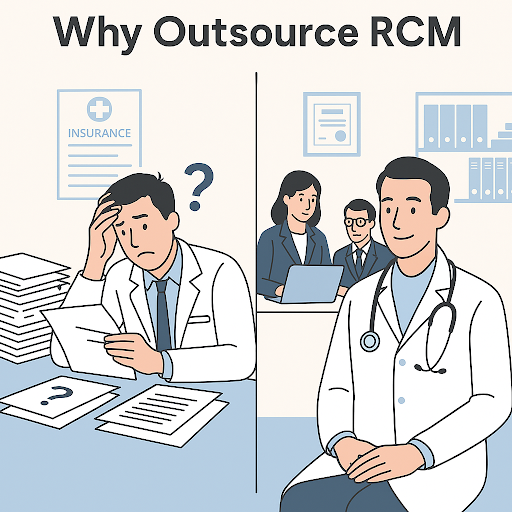
For many years, healthcare organizations viewed Revenue Cycle Management (RCM) outsourcing as a way to cut costs. The main goal was to reduce administrative work and improve profit margins. However, today’s healthcare environment is much more complex. With changing insurance rules, tighter regulations, and higher patient expectations, outsourcing RCM has become a smart and strategic move. In short, outsourcing RCM is no longer optional—it’s essential for long-term sustainability and success.”

What Is RCM?

Revenue Cycle Management (RCM) is how healthcare providers manage the financial side of patient care. It covers tasks like appointment scheduling, insurance checks, managing complex prior authorization, coding, billing, and payment collection. In essence, RCM ensures that providers are reimbursed accurately and in a timely manner

Scalable Growth for Any Practice

Healthcare providers often face changing patient numbers, service needs, and insurance requirements. Whether it is a growing hospital or a small clinic, having the ability to adapt quickly is crucial.

Outsourcing RCM gives providers the flexibility to scale their operations. An RCM partner can handle more or fewer claims as needed without the delays and costs of hiring or training staff.This agility enables providers to expand services, accommodate patient surges, and maintain operational efficiency

Better Compliance with Healthcare Regulations

Healthcare rules are always changing. Keeping up with HIPAA, insurance company rules, and new coding systems like ICD-10 takes time and effort. It can also be risky if mistakes happen.

RCM vendors focus on compliance. They have expert teams and use technology to stay up to date with all the latest rules. Their systems check for errors and make sure claims are correct before submission. This reduces the chance of audits, penalties, and claim rejections.

Faster Payments and Improved Cash Flow

Managing claims is a key part of a healthcare provider’s income. Mistakes in billing or delays in payment can cause cash flow problems.

RCM outsourcing helps speed up the entire billing process. From checking insurance eligibility to submitting claims and handling rejections, everything is done faster and more accurately. This leads to quicker payments and fewer unpaid accounts. As a result, the financial health of the practice improves.

A Better Patient Experience

Patients today expect clear, timely, and professional service—even when it comes to billing. Errors in billing or unclear statements can cause confusion and lower trust in the provider.

With an RCM partner, patients receive accurate bills and helpful support. Many vendors also offer easy payment options and customer service for billing questions. This improves the patient experience and increases satisfaction.

More Time for Patient Care

Outsourcing RCM allows healthcare teams to focus on what matters most: patient care. Instead of spending time on billing and paperwork, providers can concentrate on improving health outcomes and growing their practice.

Conclusion

RCM outsourcing is no longer just about saving money. It is a smart move that helps providers grow, stay compliant, get paid faster, and give better service to patients. In today’s  demanding healthcare environment, the question is no longer whether you can afford to outsource—but whether you can afford not to.

Categories
Hypertension Management

Recent Advances in Hypertension Management: From Precision Medicine to Device-Based Therapies

Executive Summary:

Hypertension (HTN) remains a major global health burden, leading to cardiovascular morbidity and mortality worldwide. While lifestyle modification and pharmacologic therapy remain first-line strategies, a subset of patients continue to exhibit resistant hypertension, prompting exploration of new pharmacological agents and device-based interventions.

Among recent advances, renal denervation (RDN), a minimally invasive procedure, has emerged as a promising therapy for resistant hypertension. RDN involves catheter-based ablation of renal sympathetic nerves to reduce excessive sympathetic activity, a key contributor to high blood pressure (BP).

Recent clinical trials, such as SPYRAL HTN-ON MED, SPYRAL HTN-OFF MED, and RADIANCE-HTN have demonstrated significant BP reductions with RDN. Improved catheter designs and refined procedural techniques enhance precision, minimizing complications.

Beyond RDN, advances in antihypertensive drug development, such as dual endothelin receptor antagonists (e.g., aprocitentan) and aldosterone synthase inhibitors, as well as mineralocorticoid receptor antagonists, are offering new pathways for blood pressure control.

In an era of precision medicine, digital health innovations—such as remote BP monitoring, AI-driven therapeutic guidance, and mobile adherence tools—are augmenting traditional management approaches.

In summary, precision medicine and device-based therapies promise to revolutionize hypertension care, reducing cardiovascular risks and improving patient quality of life.

Hypertension (HTN), commonly known as high blood pressure, remains one of the most pervasive chronic conditions globally. According to the World Health Organization (WHO), approximately 1.28 billion adults aged 30–79 years are affected by hypertension worldwide, with two-thirds living in low- and middle-income countries (WHO, 2021). Despite well-established treatment options involving lifestyle modification and medications, a significant subset of patients have resistant hypertension—failure to achieve adequate blood pressure (BP) control in spite of 3 or more medications.

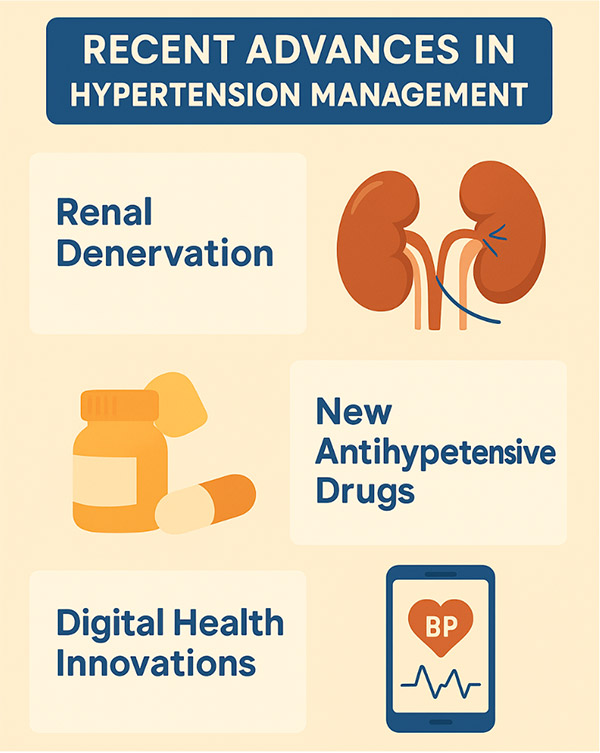
Recent advances in device-based therapies, novel pharmacological agents, and digital health tools are transforming how clinicians manage hypertension in the era of precision medicine.

What Is Resistant Hypertension?

Resistant hypertension is defined as blood pressure that remains above target despite the concurrent use of three antihypertensive drugs of different classes, one of which is usually a diuretic, at optimal doses. It is estimated that 10–20% of hypertensive individuals may fall into this category.

1. Renal Denervation (RDN): A Game-Changer in Resistant Hypertension

Renal denervation (RDN) is a minimally invasive, catheter-based procedure that reduces renal sympathetic nerve Excessive renal sympathetic drive is a known contributor to hypertension, and RDN addresses this issue directly. Ablation can be done by radiofrequency or ultrasound or drugs..

Key Clinical Trials:
  • SPYRAL HTN-OFF MED Trial: This trial involved patients not on antihypertensive medications. RDN led to a mean reduction of 5.5 mmHg in 24-hour systolic BP compared to the sham group (Townsend et al., 2017).
  • SPYRAL HTN-ON MED Trial: Evaluated RDN in patients already taking medications. Results showed a significant reduction of 9.0 mmHg in office systolic BP (Kandzari et al., 2021).

These trials have reaffirmed RDN as a safe and effective option, especially for patients who are either medication-intolerant or have an inadequate response despite therapy.

2. New kids on the block

Aprocitentan: Dual Endothelin Receptor Antagonist

Aprocitentan works by inhibiting the binding of endothelin-1 (ET-1) to both ETA and ETB receptors, reducing vasoconstriction and sodium retention. In the PRECISION trial, aprocitentan demonstrated sustained BP reduction in resistant hypertension over 48 weeks.

Aldosterone Synthase Inhibitors (ASIs)

ASIs are a class of drugs that target the final enzyme in the process of aldosterone production, called aldosterone synthase (CYP11B2). By inhibiting this enzyme, ASIs reduce circulating aldosterone levels directly. This reduction in aldosterone leads to decreased sodium and water reabsorption, resulting in lower blood volume and blood pressure. 

Next-Generation Mineralocorticoid Receptor Antagonists (MRAs)

Finerenone, a novel mineralocorticoid receptor antagonist (MRA), that selectively blocks MR overactivation in the heart and kidneys. It has a lower risk of hyperkalemia than older drugs like spironolactone and provides cardiorenal protection, particularly in patients with chronic kidney disease and diabetes.

3. Digital Health Innovations in Hypertension Care

Digital tools are redefining hypertension care through remote monitoring, data analytics, and personalized treatment.

Remote BP Monitoring

Wearable and home-based BP monitors now allow patients to track their BP daily and share data with providers in real time, reducing misdiagnosis and white coat HTN.

AI-Based Decision Support

Artificial intelligence is being used to optimize medication regimens, detect trends, and provide alerts for BP fluctuations, increasing care precision.

Conclusion: Toward Precision and Personalization

The management of hypertension is undergoing a paradigm shift with innovations in interventional procedures, drug development, and digital health. The integration of renal denervation, advanced pharmacologic agents, and AI-powered tools offers personalized, effective, and sustainable solutions, particularly for individuals with resistant hypertension.

Ongoing research and long-term follow-ups will be crucial in incorporating these approaches into routine clinical practice and making them accessible across all healthcare settings.

By ACH

Chase
Global Health Forum, Inc.
Account number: 686392278
Routing number (ACH/Wire): 021000021

By Check

RAJEEV KAUL CPA PC
303-5th Avenue, Suite # 1007
New York, NY-10016